
PAID
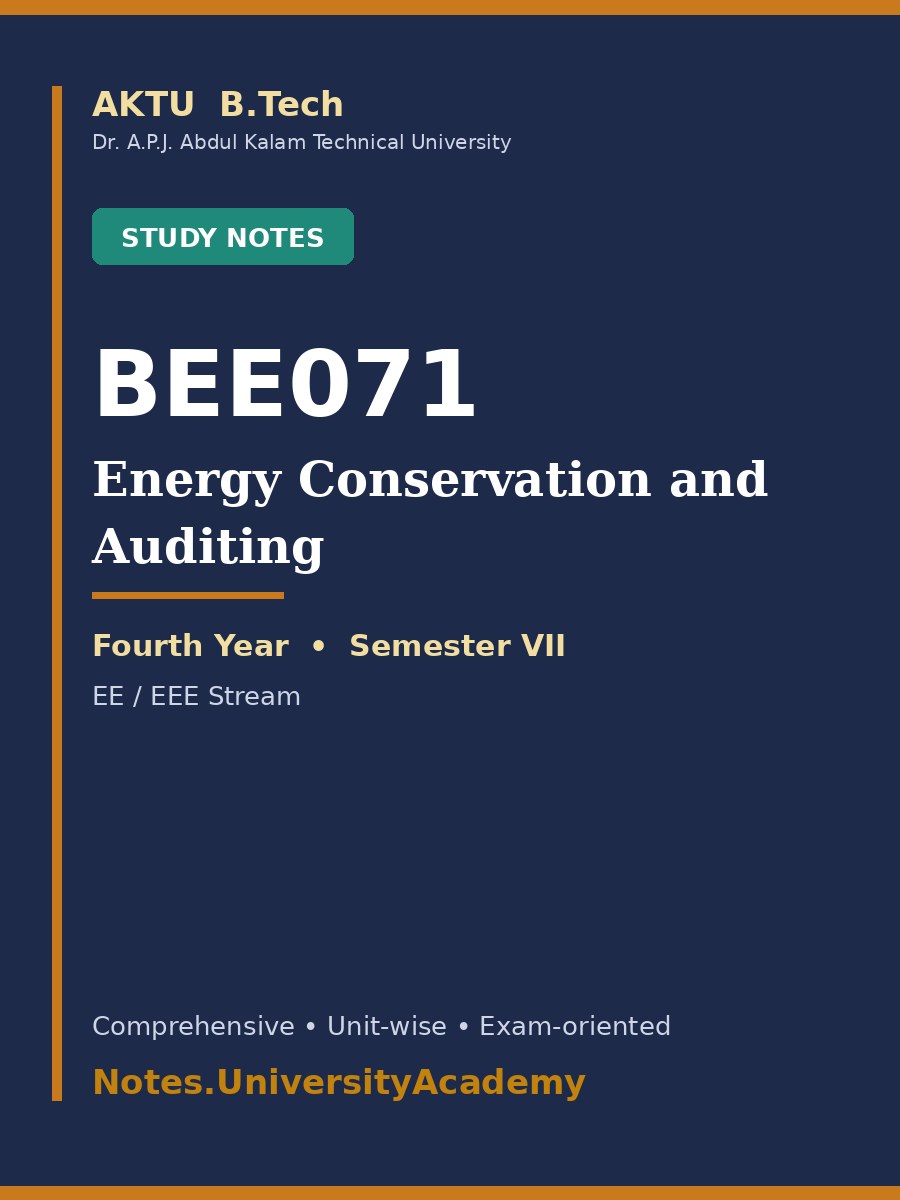
AKTU B.Tech. BEE071 Energy Conservation and Auditing Comprehensive Study Notes
Energy Conservation and Auditing BEE071
All syllabus, notes, question bank & PYQ for this subject
by EduQuest by University Academy & ExamCompetition
- English
- 151 pages
- Semester 7
- 0 downloads
- 0 views
This EduQuest comprehensive study notes supports exam preparation for Dr. A.P.J. Abdul Kalam Technical University (AKTU) B.Tech. Fourth Year, Electrical Engineering / Electrical and Electronics Engineering (EE / EEE), Semester VII. It follows the official syllabus of Energy Conservation and Auditing (course code BEE071) (Department Elective IV) unit by unit.
What is included
- Complete official syllabus of the subject, unit by unit, with course outcomes and reference books.
- Detailed exam-oriented theory for every topic with block diagrams, figures and derivations.
- Solved numericals and worked examples in step-by-step examination format.
- Previous-year AKTU questions mapped to the units they come from.
- MCQs with answers, comparison tables, formula cards, glossary and a last-day revision checklist.
Unit-wise syllabus coverage
- Unit 1 – Energy Scenario; Energy Conservation Act 2001 and Related Policies: Classification of energy, Indian energy scenario, sectoral energy consumption (domestic, industrial and other sectors), energy needs of a growing economy, energy intensity, long-term energy scenario, energy pricing, energy security, energy conservation and its importance, energy strategy for the future. Energy Conservation Act 2001 and its features, notifications under the Act, schemes of the Bureau of Energy Efficiency (BEE) including designated consumers, State Designated Agencies, Electricity Act 2003, Integrated Energy Policy, National Action Plan on Climate Change, ECBC code for building construction.
- Unit 2 – Demand Side Management; Energy Monitoring and Targeting: Concept and scope of DSM, difference between energy efficiency and DSM, evolution of DSM, DSM strategy, planning, implementation and application, customer acceptance and implementation issues, national and international experiences with DSM, UDAY scheme and other government initiatives for DISCOMs. Defining monitoring and targeting, elements of M&T, data and
- Unit 3 – Energy Audit: Aim of energy audit, strategies of energy audit, energy management team, considerations in implementing an energy-conservation programme, process flow diagram, energy audit report format, benchmarking and energy performance, instruments for energy audit, economic analysis.
- Unit 4 – System Audit of Mechanical Utilities: Pumps — types and application, unit assessment, improvement options, parallel and series operating pump performance; energy saving in pumps and pumping systems. Blowers — types and application, performance assessment, series and parallel operation, applications and advantages; energy saving in blowers. Compressors — types and applications, specific power consumption, compressed-air system and economics of system changes; energy saving in compressors and compressed-air systems. Cooling towers — types, performance assessment and limitations, water loss in cooling towers. Case studies related to energy audit and management in industries.
- Unit 5 – Energy Efficient Technology: Need for energy-efficient devices, life-cycle assessment, comparison between simple payback and life-cycle cost assessment, energy-efficient motors — motor losses and loss-reduction techniques, determining and comparing motor efficiencies, motor-efficiency testing standards, BIS specification for energy-efficient motors, efficiency as a function of load; energy-efficient lighting sources — CFL, LED, LED lamp, role of voltage on the efficiency of lighting systems; importance of automatic power-factor controllers; variable frequency drives.
Details
- Subject code: BEE071
- Subject: Energy Conservation and Auditing
- Programme: B.Tech., Fourth Year, Semester VII
- Branch: Electrical Engineering / Electrical and Electronics Engineering (EE / EEE)
- University: AKTU, Lucknow
- Pages: 151
- Format: PDF, English
Prepared by EduQuest by University Academy & ExamCompetition. More study resources at universityacademy.in
Ratings & Reviews
No reviews yet — share your experience with this item.