
PAID
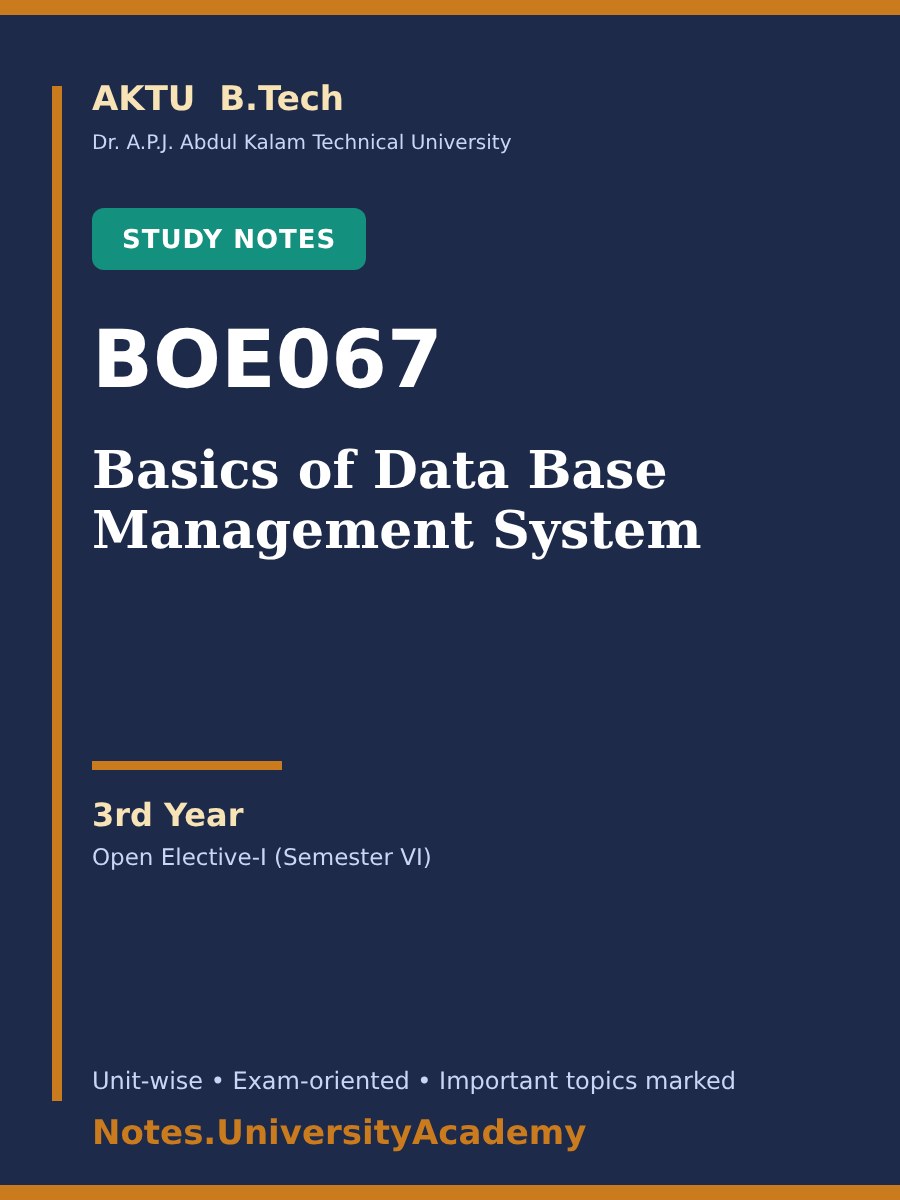
AKTU B.Tech. BOE067 Basics of Data Base Management System Study Notes
Basics of Data Base Management System BOE067
All syllabus, notes, question bank & PYQ for this subject
by EduQuest by University Academy & ExamCompetition
- English
- 159 pages
- Semester 6
- 0 downloads
- 2 views
AKTU B.Tech. Basics of Data Base Management System Study Notes
This EduQuest study notes PDF supports exam preparation for Dr. A.P.J. Abdul Kalam Technical University (AKTU) B.Tech. 3rd Year (Open Elective-I (Semester VI)). It follows the official syllabus of Basics of Data Base Management System (course code BOE067) unit by unit, in simple exam-oriented language.
What is included
- Complete syllabus as prescribed by AKTU, with course objectives, outcomes and text books.
- Clickable index: jump straight to any unit or topic.
- Detailed unit-wise notes covering every topic of the syllabus.
- MOST IMPORTANT and IMPORTANT topics marked for quick revision.
- Solved examples, process diagrams and short and long practice questions after each unit.
Unit-wise syllabus coverage
- Introduction: An overview of database management system, database system vs filesystem, database system concepts and architecture, views of data – levels of abstraction, data models, schema and instances, data independence, database languages and interfaces, data definition languages, DML, overall database structure, transaction management, storage management, database users and administrator. Data Modeling using the Entity Relationship Model: ER model concepts, notation for ER diagram, mapping constraints, keys, concepts of super key, candidate key, primary key, generalization, aggregation, reduction of an ER diagrams to tables, extended ER model, relationships of higher degree.
- Relational Database Concepts: Introduction to relational database, relational database structure, relational model terminology – domains, attributes, tuples, relations & relational database schema, integrity constraints, entity integrity, referential integrity, keys constraints, domain constraints, Relational algebra - relational calculus, tuple and domain calculus, basic operations – selection and projection, set-theoretic operations, join operations. Data Base Design & Normalization: Functional dependencies, normal forms, first, second, & third normal forms, BCNF, inclusion dependence, loss less join decompositions, normalization using FD, MVD, and JDs, alternative approaches to database d
- Structured Query Language (SQL): Basics of SQL, DDL, DML, DCL, advantage of SQL, SQL data type and literals, types of SQL commands, SQL operators and theirprocedure, tables – creation & alteration, defining constraints, views and indexes, queries and sub queries, aggregate functions, built-in functions, insert, update and delete operations, joins, unions, intersection, minus, transaction control commands. PL/SQL: Introduction, features, syntax and constructs, SQL within Pl/SL, DML in
- Transaction Processing Concepts: Transaction concepts, properties of transaction, testing of serializability, Serializability of schedules, conflict & view serializable schedule, recoverability, recovery from transaction failures, two-phase commit protocol, log based recovery, checkpoints, deadlock handling. Concurrency Control Techniques: Concurrency control, locking techniques for concurrency control, time stamping protocols for concurrency control, validation based protocol, multiple granularity, multi-version schemes, recovery with concurrent transaction.
- Database Security – Types of security, system failure, backup & recovery techniques, authorization & authentication, system policies, levels of security – physical, OS, network & DBMS, privileges – grant & revoke. Recent Trends in Database Management Systems: Centralized and Client-Server Architectures, Distributed Databases, Object-Oriented Database, Spatial & Temporal Databases, Decision Support Systems, Data Analysis, Data Mining & Warehousing, Data Visualization, Mobile Databases, OODB & XML Databases, Multimedia & Web Databases, Spatial and Geographical Databases, Web and Mobile Databases, Active Databases
Course details
- University: Dr. A.P.J. Abdul Kalam Technical University (AKTU), Lucknow
- Programme: B.Tech. 3rd Year
- Subject: Basics of Data Base Management System
- Course code: BOE067
- Category: Open Elective-I (Semester VI)
- Credits: 3
- PDF length: 159 pages
- Format: PDF
Use these notes along with the official syllabus, your class notes and the prescribed text books.
Prepared By
EduQuest by University Academy & ExamCompetition
Ratings & Reviews
No reviews yet — share your experience with this item.